
The Chem tab
Advanced Edition
The Chem tab is fifteen periodic tables in one: pick a property from the pull-down and the whole table recolors: atomic mass, electronegativity, density, melting point, the families, the s p d f blocks, the year each element was found. Click any element for all fourteen of its properties, plot a trend down a group or across a period, drag a temperature and watch the table melt, or drag a year back to 1869 and see the holes Mendeleev predicted into. The data itself is already free in both editions: element("Fe"), chem.elements and molarMass("H2O") work in any cell.
Srivus Chem
The central science should have a place in every scientific calculator.
A printed periodic table offers one fixed perspective, and once it goes on the wall, that is the view students see all year. I wanted something more, a scientific instrument to explore, not simply a chart to reference.
So I built a periodic table with fifteen perspectives on the same 118 elements. From one simple menu, students can move among Atomic Mass, Electron Configuration, Oxidation States, Atomic Radius, Density, Electronegativity, and more.
The result is a living map of the central science, connecting chemistry, physics, mathematics, and statistics. Instead of memorizing one fixed chart, students can change the question, change the perspective, and discover the patterns for themselves.
Every element opens a detailed view, and every property can be used in a cell
Clicking on any element opens a detailed view showing all fourteen of its properties. More importantly, each of those properties can also be accessed directly from a calculator cell and used in a student's own expressions.
That connection is especially important to me. I did not want the periodic table to be a separate picture of chemistry sitting beside the mathematics. I wanted the chemistry data to be part of the same system, so students can explore it, calculate with it, and make connections between scientific information and mathematical reasoning directly within the calculator.
CO is carbon monoxide and Co is cobalt. One capital letter doubles the mass, and the calculator does not guess which you meant.
There is also a detachable trend plot under the table, so a property can be read across the whole table at once. Its axes carry real units, the pointer tells you which element it is over, and a mouse click pins a labeled card so that two or three elements can be compared side by side. The arrow keys do everything the mouse does.
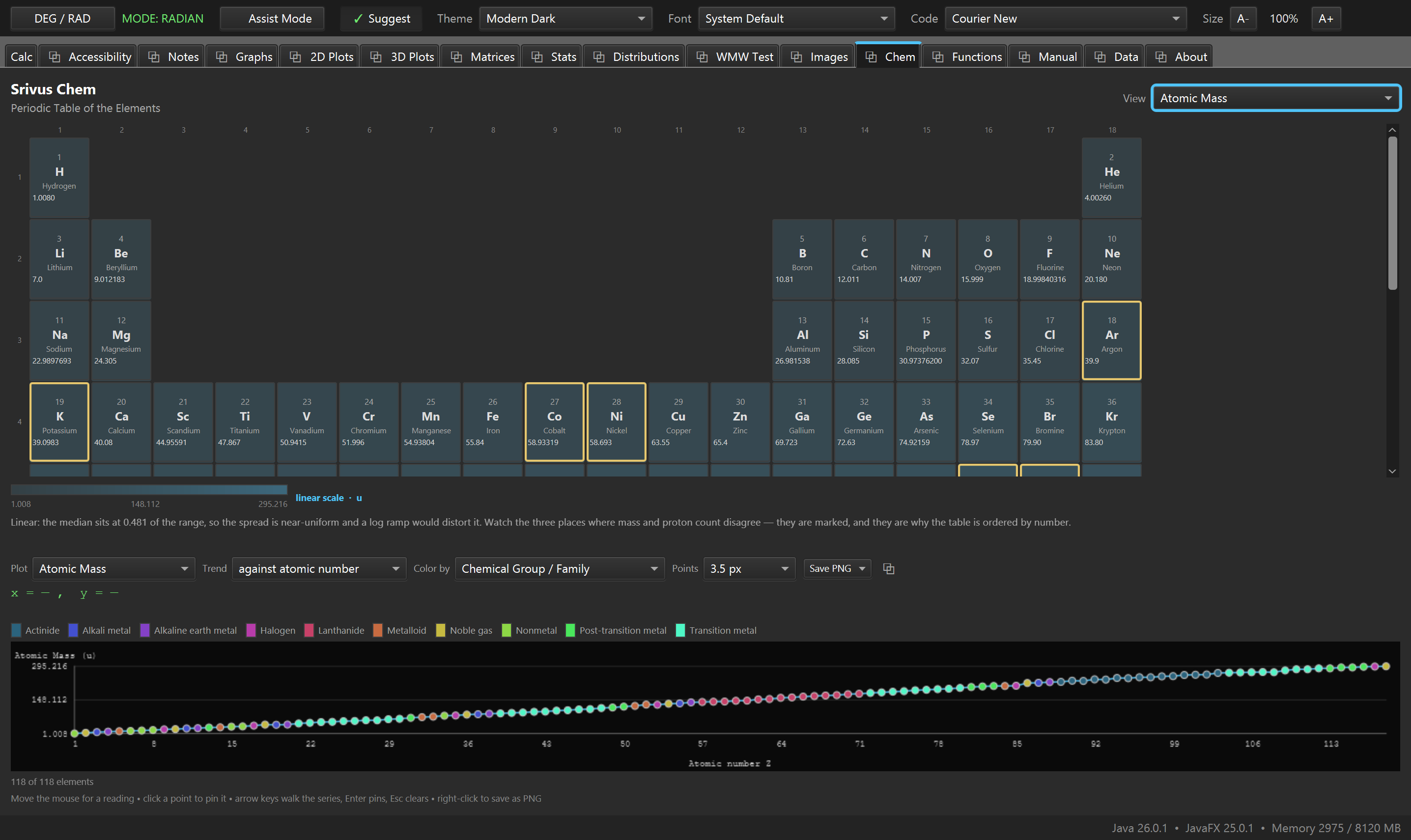
chemistry.pngChem: the default Atomic Mass view, Modern Dark, trend plot visible.
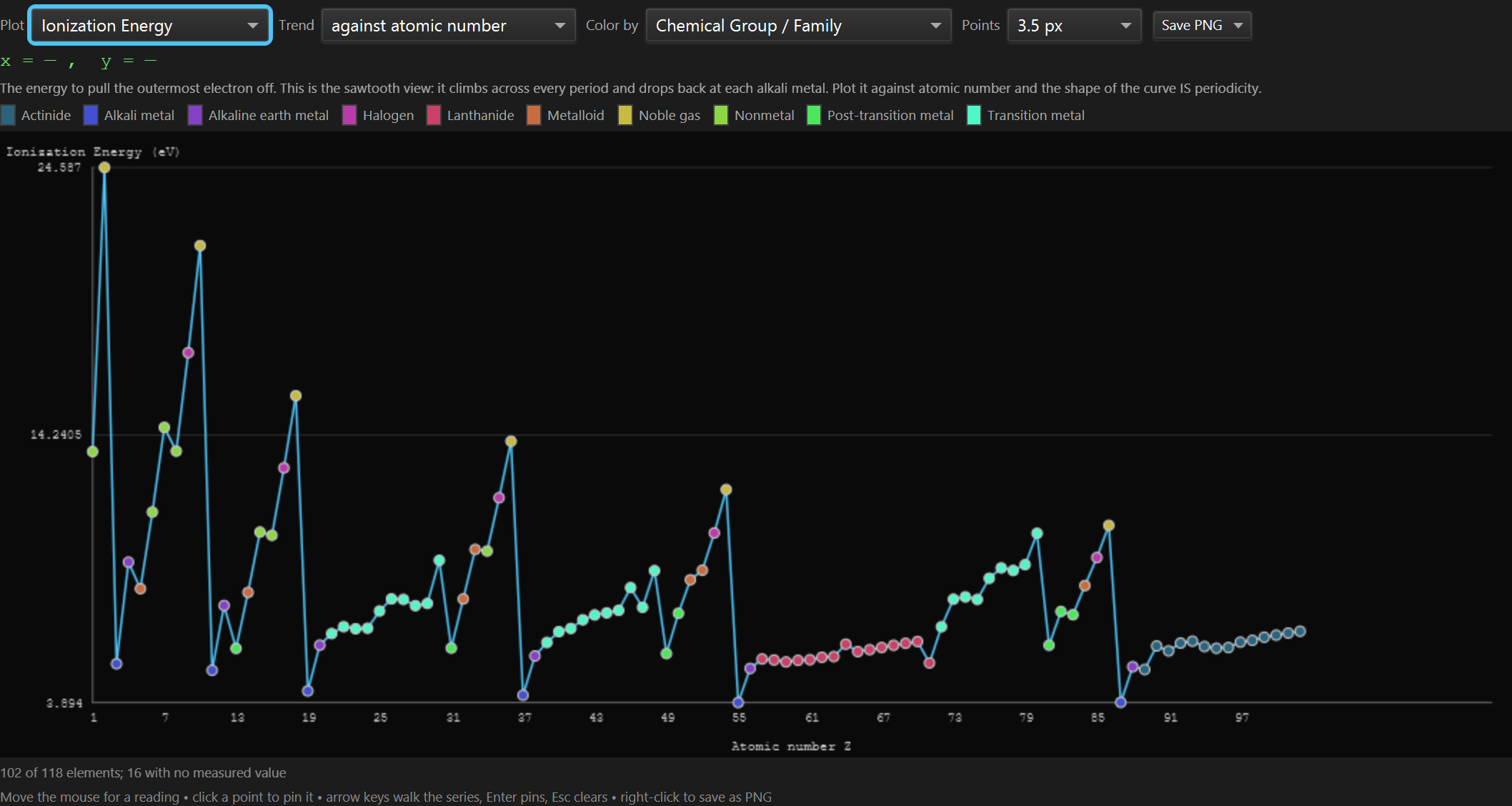
chemistry2.pngChem, the trend plot pulled out into its own window.
It is readable in every theme
The shading is computed from whichever theme you are using, and it is held to the same contrast standard as the rest of the system, so the tiles carrying the largest values are always readable. Every tile also prints its own number, so the Grayscale theme, which has no color, loses no information.
The scale is chosen per property
The ratio of the maximum density to that of the minimum in the Chart is around 251,000. The plot of densities across the Atomic Mass cannot be drawn linearly. Therefore, it is drawn logarithmically. The legend always says which scale you are looking at.
The tab is in the Advanced Edition, but the chemistry data is in both.
element("gold")["meltingpoint"], molarMass("H2O") and the whole
chem.elements table work in a cell in the free Basic Edition too.
Typed in, answered back
Every example here has been run and tested.
These are not merely illustrations; they are carefully verified examples drawn directly from the system's own reference. Every example is automatically tested, and the build will stop if even one result has changed unexpectedly. That gives us something important as teachers and scientists: a reliable connection between what we see in the manual and what the system actually does. When an example is included here, you can trust that it has been tested and works as described.
The periodic table is built in
Nested parentheses are read correctly, and the capitals carry meaning: CO is carbon monoxide, while Co is cobalt.
Chemistry as ordinary code
Which elements are liquid at room temperature? Because the periodic table is a dictionary, ordinary list vocabulary answers a real chemistry question.