The Functions tab
In both editions
A reference of every built-in function, plus the list of names you may not reuse.
Typed in, answered back
Every example here has been run and tested.
These are not merely illustrations; they are carefully verified examples drawn directly from the system's own reference. Every example is automatically tested, and the build will stop if even one result has changed unexpectedly. That gives us something important as teachers and scientists: a reliable connection between what we see in the manual and what the system actually does. When an example is included here, you can trust that it has been tested and works as described.
The functions a physics course runs into
This is the Bessel function of the second kind, which is finite everywhere except at the origin, where it diverges.
A matrix in an exponent
For a diagonal matrix, each entry becomes e raised to that entry. This is a case you can check by hand before trusting the ones you cannot.
The last two examples are recent additions, and they arrived with many others. The special
functions are included in full: both kinds of Bessel function, the Airy pair, the error
function and its relatives, the Fresnel and Dawson integrals, the exponential integrals, the
Riemann zeta and Debye functions, Lambert W, digamma, the Voigt profile, the spherical
harmonics, and the hypergeometric functions on which many of the others rest. Beside them are
the matrix functions: matrixExponential, which, given a vector as well, acts on
the vector without forming the matrix exponential itself; matrixLogarithm, its
inverse; and matrixSquareRoot. Finally, random is a class with
several members, so random.uniform(), random.integer(1, 6),
random.choice(...) and random.shuffle(...) read the way you would
say them, and every distribution the program knows can be sampled.
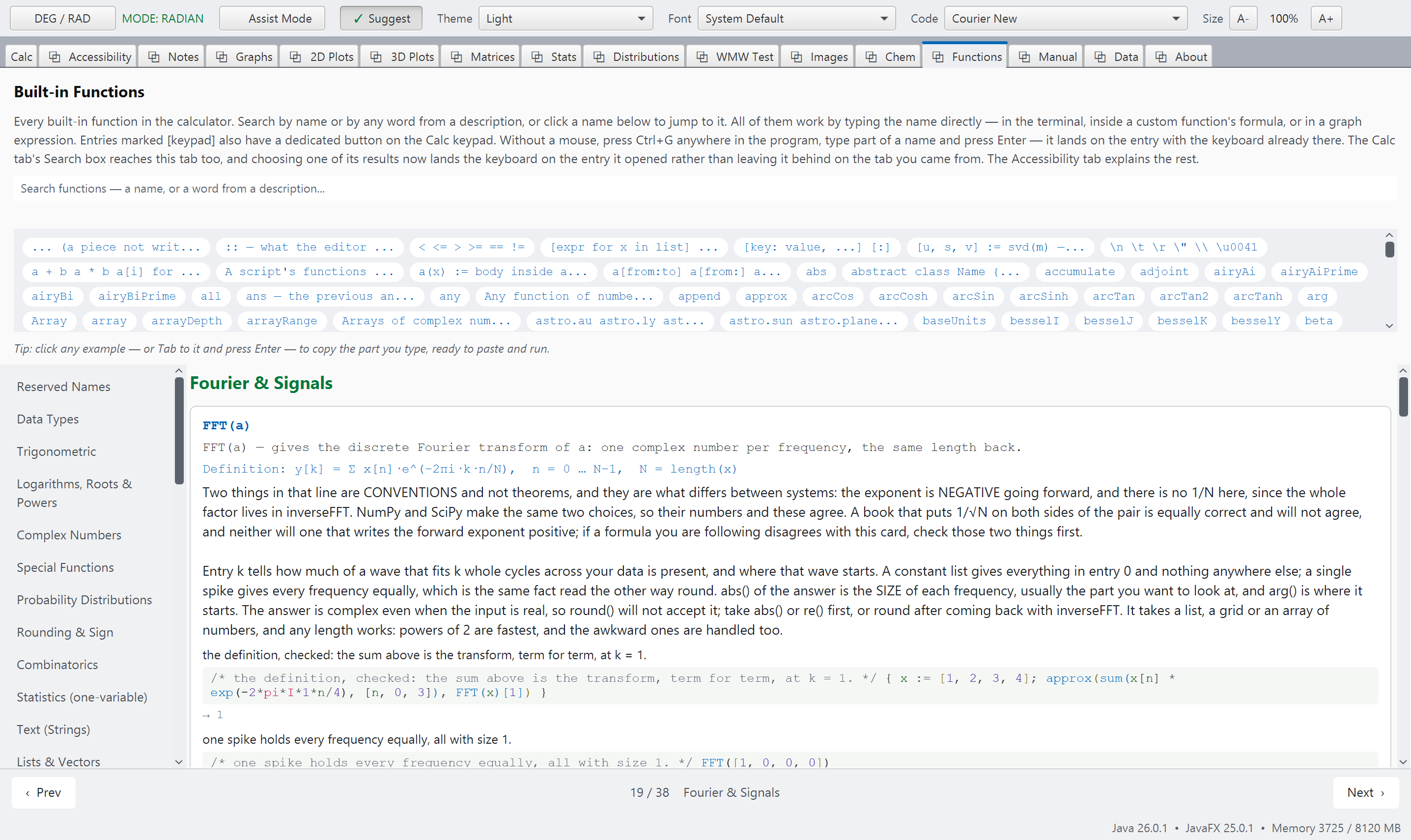
functions.pngFunctions, the reference open on a page with several entries and their examples.