The WMW Test tab
Advanced Edition
The WMW Test tab runs the Wilcoxon-Mann-Whitney rank-sum test on two samples, with exact and normal-approximation p-values and full handling of tied ranks.
What it is for
It compares two independent samples to ask whether one tends to give larger values than the other; this is the Wilcoxon-Mann-Whitney test (also called the Mann-Whitney U). It is the nonparametric cousin of the two-sample t-test: it ranks the pooled numbers instead of assuming a normal distribution, so it is the right tool for small samples, ordinal data, or skewed data with outliers. The two samples need not be the same size, and they are not paired; enter each one as you would on the Stats tab.
Running it
Type or load two data sets (A and B), then press Run Test. You get the U statistic, a two-sided p-value, the effect size (the probability of superiority, 1 - U/(nA*nB)), the two medians and which way the difference runs, and a plain-language verdict at the 0.05 level. A small p-value (below 0.05) means the two samples differ significantly; the medians tell you which sample sits higher.
Every value of B is larger than every value of A, so U is 0, and with no ties the exact p-value is 2/70.
The values 4 and 10 appear in both samples. Those ties are detected, and the exact p-value is still computed.
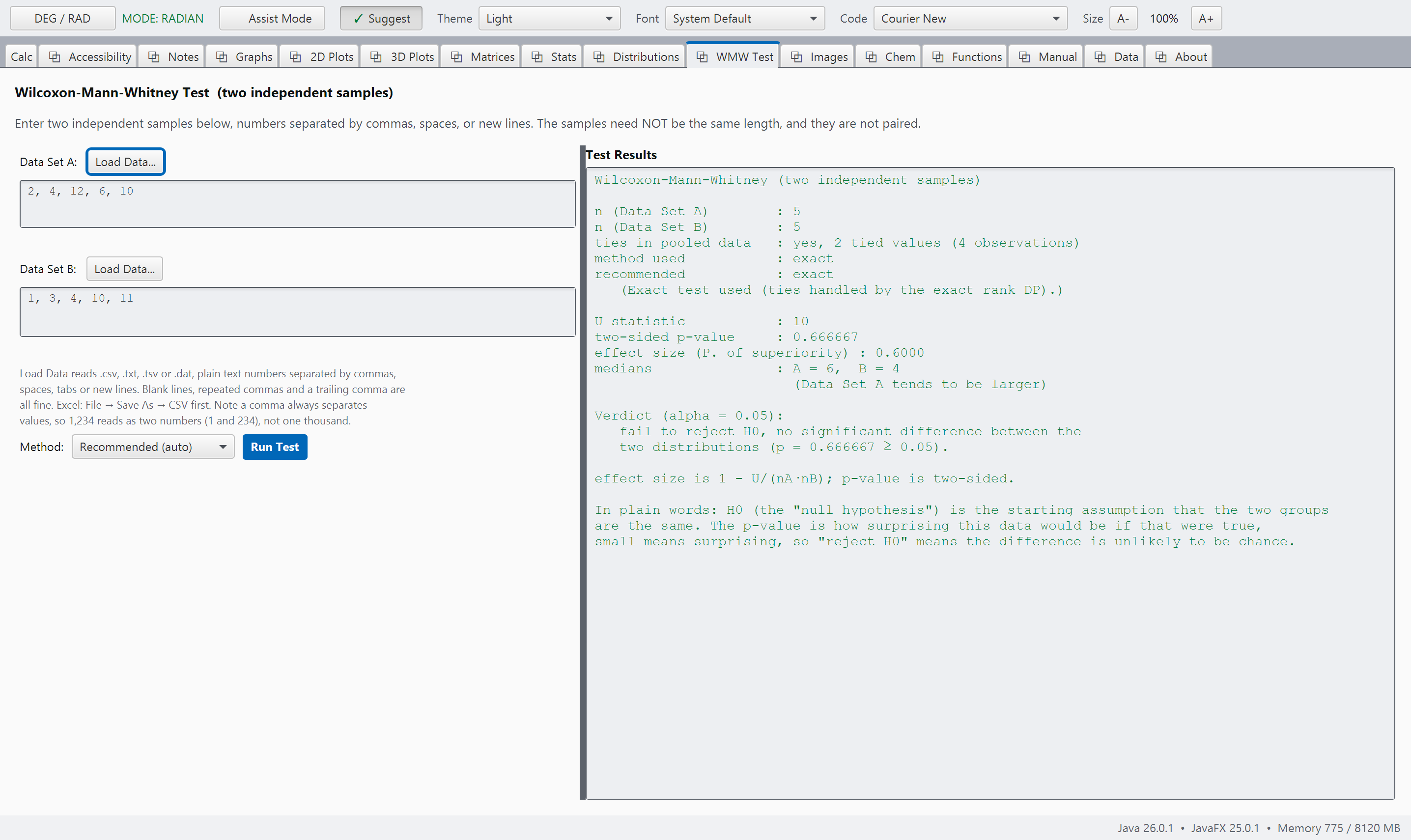
wmw-test.pngWMW Test, the manual's tied example run with the method on Recommended. See SCREENSHOT-BRIEF.md.
Ties, exact versus normal, and the recommendation
The readout tells you whether the pooled data contains ties (equal values), because ties change how the p-value is computed. You may take an exact p-value or a normal approximation, and the tab recommends one: for small samples the exact p-value is best, and the tab always computes it, even with ties, by a fast exact method that never bogs down. For large samples (more than a few hundred values in total) it recommends and uses the normal approximation, which is extremely accurate at that size. Leave the method on "Recommended" unless you have a specific reason not to.